
Padel Racket Manufacturing
How Are Padel Rackets Manufactured? A Complete Manufacturing Guide
Aug
Padel racket manufacturing combines composite materials, racket engineering, molding, surface finishing, drilling, branding and quality control. For sports brands, understanding how a padel racket is designed and manufactured is important when developing a custom, OEM or private-label product.
A padel racket may look relatively simple from the outside, but its construction involves multiple interconnected decisions. The racket shape, carbon fiber or fiberglass reinforcement, EVA foam core, resin system, weight, balance, hole pattern, paint system and final surface finish all contribute to the finished product.
In this guide, we explain the key materials, construction parameters and manufacturing stages involved in padel racket manufacturing, as well as what brands should consider when working with a padel racket manufacturer.
What Is a Padel Racket Made Of?
A padel racket is a composite sports product made from several components that work together as one structure.
The main material and construction elements can include:
- Carbon fiber or fiberglass reinforcement
- EVA foam core
- Composite frame structure
- Resin system
- Paint system
- Final surface finishing
- Drilled hole pattern
- Custom graphics and branding
The exact construction varies depending on the racket design, target player, performance requirements and product positioning.
Padel Racket Materials
Material selection is one of the most important stages in developing a padel racket. A racket’s construction is not determined by carbon fiber alone. The reinforcement material, EVA foam core, resin system, paint system and final surface finish all work together to create the finished product.
For sports brands developing custom, OEM or ODM padel rackets, materials should therefore be selected according to the intended product characteristics, target market, playing requirements and manufacturing process.
Carbon Fiber
Carbon fiber is widely used in performance-oriented padel rackets because of its high strength-to-weight characteristics and stiffness.
Different carbon constructions can be selected according to the racket design and intended product specification. Common options include 3K, 12K and 18K carbon fiber, as well as different fabric constructions such as plain weave and twill weave.
3K Carbon Fiber
3K carbon fiber uses a relatively fine carbon tow and is commonly used in composite sports products where a refined woven appearance and controlled composite construction are desired.
12K Carbon Fiber
12K carbon fiber uses a larger tow size and produces a different visual weave pattern. It can be incorporated into racket constructions according to the required design and laminate specification.
18K Carbon Fiber
18K carbon fiber uses an even larger tow size and creates a distinctive visual pattern. It can be selected for specific product designs and aesthetic requirements.
Plain Weave vs Twill Weave
Carbon fiber can also be supplied in different weave patterns. Plain weave creates a regular woven pattern, while twill weave produces the characteristic diagonal pattern commonly seen on composite products.
The carbon designation or weave pattern alone does not determine the final performance of a padel racket. The complete laminate, fiber orientation, resin system, EVA core, racket geometry and manufacturing process all contribute to the finished construction.
Fiberglass
Fiberglass is another important reinforcement material used in composite padel racket construction.
Compared with carbon fiber-oriented constructions, fiberglass can be used for product concepts targeting different combinations of flexibility, comfort, durability and cost.
Fiberglass can also be incorporated into hybrid composite constructions together with carbon fiber, depending on the desired product specification.
For brands developing a padel racket collection, the choice between carbon fiber and fiberglass should not be based simply on which material is considered better. Instead, the material should be selected according to the complete construction, target player, product positioning and manufacturing requirements.
EVA Foam Core
EVA foam forms the core of many padel racket constructions and is an important component in determining the racket’s overall response and feel.
Different EVA characteristics can be selected depending on the intended product specification.
Soft EVA
Soft EVA can be selected when a softer and more comfortable response is desired.
Medium EVA
Medium EVA can provide a balanced starting point for racket concepts intended for a broad range of players and playing characteristics.
Hard EVA
Hard EVA can be considered for designs targeting a firmer and more direct response.
The core should not be evaluated independently from the rest of the racket. Foam characteristics interact with racket geometry, composite layers, resin system, surface construction and overall weight distribution.
Resin System
The resin system is a critical part of composite padel racket construction because it bonds the reinforcement materials and forms the matrix surrounding the fibers.
In composite manufacturing, epoxy resin systems can be used with reinforcement materials such as carbon fiber and fiberglass.
Important considerations can include:
- Resin and hardener system
- Mixing ratio
- Resin viscosity
- Fiber wet-out
- Processing requirements
- Cure characteristics
- Bonding performance
- Final composite properties
A resin system should not be considered separately from the reinforcement material. The final composite depends on the interaction between the fiber, resin, core, laminate design and manufacturing process.
Paint System
The paint system gives the racket its color and forms an important part of the product’s visual presentation and surface preparation.
A padel racket may pass through several coating stages depending on the required product specification.
Surface Preparation
The molded and prepared surface is treated to provide a suitable base for subsequent coating.
Primer or Surfacing Layer
Where required, a primer or surfacing layer can help prepare the surface for the following coating stages.
Base Coat
The base color is applied according to the approved product design.
Graphics and Branding
Custom graphics, logos, product names and other visual elements can then be applied according to the brand specification.
Clear Coat or Lacquer
A final coating can be used to protect the graphics and establish the required surface appearance.
The exact coating system depends on the required finish, production process, product specification and performance requirements.
Final Surface Finishing
Final surface finishing establishes the racket’s final visual and tactile characteristics after the main coating and graphics processes.
Matte Finish
A matte finish provides a low-reflection appearance and is commonly used for clean, understated product designs.
Gloss Finish
A gloss finish creates a brighter and more reflective surface appearance.
High-Gloss Finish
High-gloss finishing can be used when a highly polished visual appearance is required.
Textured or Rough Finish
Textured finishes can be developed when a different tactile and visual surface is required.
For premium OEM and private-label products, final surface finishing should be treated as an important part of the product specification rather than simply the last cosmetic step.
Padel Racket Construction
Padel racket construction involves more than combining a face material with an EVA core. The racket’s shape, dimensions, weight, balance, hole pattern and internal construction all need to work together according to the intended performance and target market.
For custom and OEM/ODM racket development, these parameters can be considered individually and then optimized as a complete product.
Padel Racket Shapes
Racket shape is one of the first decisions in product development because it influences the overall geometry, balance, sweet-spot positioning and intended playing characteristics.
Round Padel Racket
Round rackets are generally associated with a more control-oriented design. Their geometry can provide a more centrally positioned sweet spot and can be suitable for players who prioritize consistency and control.
Teardrop Padel Racket
Teardrop is a versatile shape that can be developed to provide a balance between power and control. Its geometry makes it a popular platform for developing all-round racket concepts across different player levels.
Diamond Padel Racket
Diamond-shaped rackets are commonly developed for aggressive, power-oriented products. The geometry can be combined with a higher balance and other construction characteristics to create a racket aimed at attacking players.
The shape itself does not determine performance. Core, laminate, weight, balance, hole pattern and overall geometry must also be considered.
Padel Racket Weight and Balance
Weight and balance are important parts of racket construction because they affect how the racket feels during movement and impact.
Racket Weight
Overall racket weight is determined by the combination of composite materials, EVA core, resin content, frame construction, surface coatings, graphics and other structural components.
Weight targets should be established during product development so that production can maintain consistency between rackets.
Racket Balance
Balance describes the distribution of mass along the racket. A racket can be developed toward different balance characteristics depending on its geometry and intended playing style.
Higher-balance constructions can be developed for more power-oriented designs, while more centrally or lower-balanced constructions can be developed for products emphasizing maneuverability and control.
Balance should not be considered independently from total weight. The combination of weight, balance, shape, core and composite construction determines much of the racket’s overall feel.
Padel Racket Hole Patterns and Customization
The hole pattern is another important part of padel racket construction.
Holes are distributed across the racket face according to the approved design and tooling specification. Their arrangement contributes to the overall appearance and forms part of the racket’s engineered face construction.
For custom racket development, brands may consider:
- Hole diameter
- Hole quantity
- Hole spacing
- Hole distribution
- Hole pattern
- Position relative to the racket geometry
Hole customization should not be treated purely as a visual modification. Changes to the hole pattern can affect the face construction and should therefore be evaluated as part of the complete racket design.
Padel Racket Geometry and Construction
Shape, weight, balance and hole pattern are interconnected.
For example, changing the racket shape can affect its balance and sweet-spot position. Changing the material construction can affect weight, while changing the hole pattern can require adjustments to the face design.
Therefore, custom racket development should not treat each specification as an isolated choice.
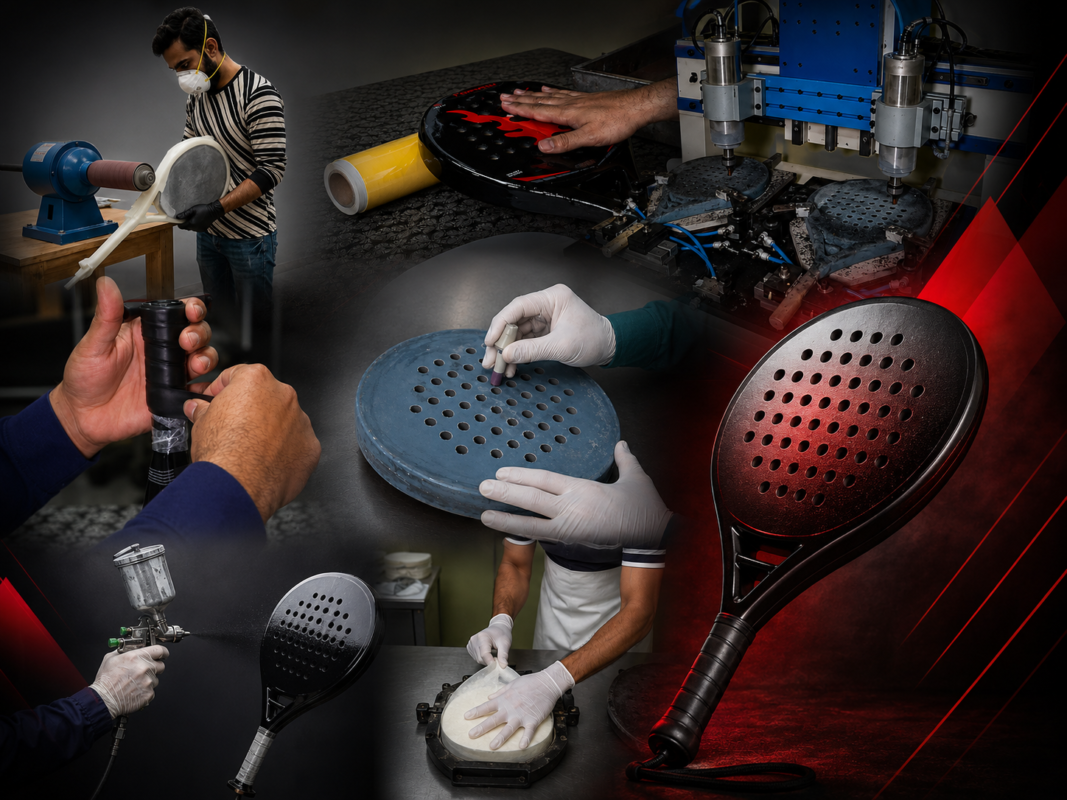
How Are Padel Rackets Manufactured?
The exact production process can vary according to the racket construction and manufacturing technology, but a commercial padel racket can pass through numerous production stages.
Material Preparation → Composite Layup → Core Assembly → Molding → Demolding → Deburring → Surface Preparation → Sanding → Filling → Painting → Drilling → Cleaning → Graphics → Surface Finishing → Quality Control → Packaging
Material Preparation
Carbon fiber, fiberglass, EVA foam, resin systems and other required materials are prepared according to the approved product specification.
Composite Layup
Reinforcement layers are prepared and positioned according to the racket construction and laminate specification.
EVA Core Preparation
The EVA core is prepared according to the approved racket geometry and construction requirements.
Racket Molding
The prepared construction is formed using the appropriate tooling and molding process.
Demolding and Initial Inspection
The molded racket is removed from the tooling and checked for visible manufacturing issues.
Deburring
Excess material and unwanted edges are removed to prepare the racket for surface finishing.
Sanding and Surface Preparation
The surface is prepared for filling, painting, graphics and subsequent finishing operations.
Surface Filling
Where required, surface imperfections are corrected before painting and finishing.
Paint Application
The racket receives its specified coating and base color according to the approved product design.
Hole Drilling
The approved hole pattern is produced according to the racket design and tooling specification.
Hole and Surface Cleaning
The racket is cleaned and prepared for graphics, branding and final finishing operations.
Graphics and Branding
Brand logos, graphics, product names and other approved artwork are applied according to the product specification.
Surface Finishing
The racket receives its specified matte, gloss, textured or other final surface treatment.
Final Quality Inspection
The finished racket is checked against the approved product specification before packaging.
Quality Control in Padel Racket Manufacturing
Quality control should not be treated as a single final inspection. A reliable manufacturing process uses checks throughout production.
Important quality parameters can include:
- Overall dimensions
- Racket weight
- Balance
- Surface quality
- Hole pattern
- Edge finishing
- Graphics and branding
- Structural consistency
- Cosmetic appearance
- Packaging
For brands ordering commercial quantities, consistency between individual rackets is particularly important.
A sample that performs well is only useful if the manufacturing process can reproduce the approved specification consistently at scale.
Custom Padel Racket Development
One of the biggest advantages of working directly with a manufacturer is the ability to develop a racket around a specific brand concept.
Product Brief
The brand defines its target market, player level and desired product positioning.
Shape Selection
Round, teardrop or diamond geometry can be selected according to the intended product concept.
Material Selection
Carbon fiber, fiberglass and other composite construction options can be evaluated.
Core Selection
The appropriate EVA characteristics can be selected.
Weight and Balance
Target weight and balance can be established according to the product requirements.
Hole Pattern
The required hole design and drilling specification can be established as part of the racket engineering.
Surface and Graphics
The brand’s visual identity is translated into the racket design.
Prototype and Sample
A sample is produced for evaluation before commercial production.
Testing and Approval
The brand evaluates the sample and provides feedback before the final specification is approved.
Production
After approval, the final specification is used for commercial production.
OEM vs ODM Padel Racket Manufacturing
Brands entering the padel market commonly consider two manufacturing models: OEM and ODM.
What Is OEM Padel Racket Manufacturing?
OEM manufacturing is suitable when a brand has its own specifications, product concept or design requirements. The manufacturer produces the racket according to the agreed specifications.
What Is ODM Padel Racket Manufacturing?
ODM manufacturing can be suitable for brands that want to start from an existing manufacturing platform or product concept and customize it for their market.
Customization can include:
- Graphics
- Colors
- Branding
- Surface finish
- Selected materials
- Product specifications
Private Label Padel Rackets
Private-label manufacturing allows a sports business to sell padel rackets under its own brand identity without necessarily developing every aspect of the manufacturing process from scratch.
A private-label project may involve:
- Existing racket platforms
- Custom branding
- Custom graphics
- Packaging
- Selected materials
- Product specifications
This can provide a practical route for businesses looking to enter the padel market while maintaining control over their own brand identity.
How to Choose a Padel Racket Manufacturer
Price should not be the only factor when selecting a manufacturing partner.
Manufacturing Capability
Does the manufacturer have the equipment, processes and experience required for the product?
Material Options
Can the manufacturer work with the required carbon fiber, fiberglass, EVA and resin specifications?
Customization
Can the manufacturer support the desired shape, hole pattern, graphics, branding and finishing?
Sampling
Can the manufacturer produce samples before bulk production?
Quality Control
Does the manufacturer have a defined quality control process?
Communication
Can technical requirements and design changes be communicated clearly?
Production Capacity
Can the manufacturer support the required production volume as the brand grows?
Why Manufacturing Consistency Matters
For a sports brand, producing one good racket is not enough.
The real challenge is reproducing the approved product consistently across production.
A professional manufacturing system therefore needs to control the production process from material preparation through final inspection.
Consistency can affect:
- Product quality
- Player experience
- Brand reputation
- Customer satisfaction
- Product returns
- Long-term brand growth
Why Work With LeoEdge Enterprises?
LeoEdge Enterprises provides composite sports product manufacturing with a focus on customized and private-label solutions.
Our manufacturing capabilities cover padel rackets, field hockey products, sportswear and other composite sports products, allowing sports brands to work with a manufacturing partner across multiple product categories.
For padel racket development, brands can discuss requirements around:
- Racket shape
- Carbon fiber or fiberglass construction
- EVA core
- Weight and balance
- Hole pattern
- Surface finish
- Graphics
- Branding
- Product development
- OEM and ODM manufacturing
Our objective is to help brands move from a product concept to an approved production specification and then into consistent commercial manufacturing.
Learn more about LeoEdge Enterprises and our approach to OEM and ODM sports manufacturing.
Frequently Asked Questions
Padel rackets commonly use composite reinforcement such as carbon fiber or fiberglass together with an EVA foam core and other structural and finishing materials.
Neither material is universally better for every product. The appropriate choice depends on the intended performance, construction, product positioning and manufacturing requirements.
3K, 12K and 18K describe the tow size used in the carbon fiber fabric. The final characteristics of a racket depend on the complete construction rather than the K designation alone.
There is no single best shape for every player. Round, teardrop and diamond shapes can be developed for different playing characteristics and product requirements.
Yes. Sports brands can work with an OEM or ODM manufacturer to develop customized or private-label padel rackets.
Weight and balance can be specified as part of product development, subject to the manufacturing process, construction and agreed product requirements.
Hole patterns can be developed as part of a custom racket specification, including factors such as hole diameter, quantity, spacing and distribution. Changes should be evaluated as part of the complete racket design.
Yes. A sample allows a brand to evaluate the product specification, appearance, weight, balance, finishing and overall requirements before larger production.
OEM generally involves manufacturing according to a customer’s specifications, while ODM typically starts from an existing manufacturer product platform or concept that can be customized for the brand.
Final Thoughts
A high-quality padel racket is the result of many manufacturing decisions working together.
From carbon fiber and EVA foam selection to racket geometry, resin systems, paint, final surface finishing, molding, drilling, branding and quality control, every stage contributes to the final product.
For sports brands, choosing the right padel racket manufacturer is therefore about more than finding the lowest price. The right manufacturing partner should understand product development, materials, customization, quality control and the commercial requirements of the target market.
Whether you are developing your first racket collection, expanding an existing sports brand or looking for an OEM/ODM manufacturing partner, a clearly defined product specification and controlled manufacturing process are the foundation of a successful padel racket.
Develop Your Own Padel Racket With LeoEdge
Have a racket concept, brand or product specification?
Talk to LeoEdge Enterprises about custom, OEM and ODM padel racket manufacturing.
Start Your Custom Padel Racket Project