
Padel Racket Manufacturing
3K vs 12K vs 18K Carbon Fiber for Padel Rackets
Aug
When developing a performance padel racket, carbon fiber is one of the most discussed reinforcement materials. But choosing between 3K, 12K and 18K carbon fiber for padel rackets is not simply a matter of choosing the highest number.
The terms 3K, 12K and 18K describe the approximate number of individual carbon filaments in a tow. Different tow sizes create different fabric appearances and can be incorporated into different composite constructions.
For racket manufacturers and sports brands, the more important question is how the carbon fabric works together with the fiber orientation, laminate design, resin system, EVA core, racket geometry, weight and manufacturing process.
This guide explains the difference between 3K vs 12K vs 18K carbon fiber for padel rackets, what the K designation actually means, and how brands can select a suitable carbon construction for a custom or OEM padel racket.
What Does 3K, 12K and 18K Mean in Carbon Fiber?
The K designation in carbon fiber refers to tow size. In simple terms, it describes how many individual carbon filaments are grouped together in a tow.
In composite fabrics, these tows are woven into the fabric used to reinforce a product. Therefore, 3K, 12K and 18K carbon fabrics have different visual weave characteristics and can be selected for different product constructions.
When comparing carbon fiber for padel rackets, manufacturers should therefore look beyond the K number and consider the complete laminate specification.
3K Carbon Fiber for Padel Rackets
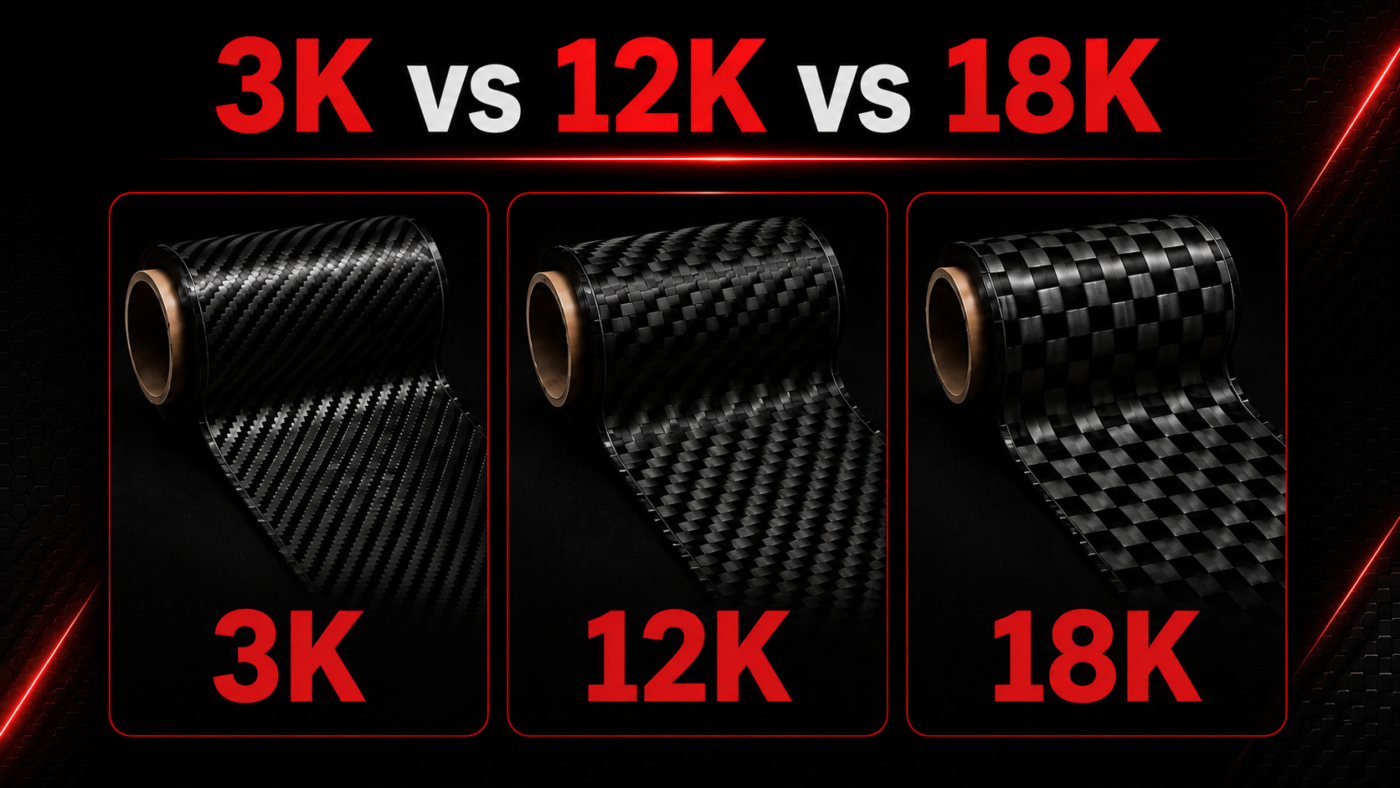
3K carbon fiber uses a relatively fine carbon tow. It is commonly associated with a refined woven appearance and is widely recognized in composite sports products.
3K Carbon Fiber Appearance
The smaller tow produces a fine and relatively detailed weave pattern. This can be attractive for premium product designs where the visible carbon texture is part of the product’s visual identity.
3K Carbon Fiber in Racket Construction
In a padel racket, 3K fabric can be incorporated into the laminate according to the required layer count, orientation, resin system and construction design.
The final result depends on much more than the carbon designation. The same 3K fabric can produce different composite characteristics when used with different laminate structures, resin contents, core materials and racket geometries.
12K Carbon Fiber for Padel Rackets
12K carbon fiber uses a larger tow than 3K. This creates a different woven appearance and can be selected when a manufacturer wants a different carbon texture or composite fabric construction.
12K Carbon Fiber Appearance
The larger tow produces a more pronounced weave pattern than a fine 3K fabric. For some racket designs, this visual pattern can become an important part of the product’s appearance.
12K Carbon Fiber in Racket Construction
12K fabric can be used as part of a composite laminate when its fabric construction and the rest of the racket specification are engineered together.
It should not be assumed that changing from 3K to 12K alone automatically changes a racket’s playing characteristics in a predictable way. Laminate architecture, fiber orientation, resin content, core and geometry remain important.
18K Carbon Fiber for Padel Rackets
18K carbon fiber uses a larger tow size than both 3K and 12K. The larger tow creates a distinctive and more pronounced woven appearance.
18K Carbon Fiber Appearance
18K fabric can create a bold carbon pattern that may suit particular premium or performance-oriented product designs.
18K Carbon Fiber in Racket Construction
As with 3K and 12K, the suitability of 18K carbon depends on the complete laminate specification and manufacturing process. The tow size by itself should not be treated as a complete performance specification.
3K vs 12K vs 18K Carbon Fiber: Key Differences
The simplest way to understand the three carbon fiber options is to compare their tow size, visual weave characteristics and how they may fit into a racket development program.
3K Carbon
Smaller tow size with a fine woven appearance. Suitable for composite constructions where a refined carbon texture is desired.
12K Carbon
Larger tow than 3K with a more pronounced weave pattern. Can be incorporated into different laminate constructions.
18K Carbon
Larger tow size with a distinctive visual pattern. Can be selected for specific product and design requirements.
| Carbon Fiber | Tow Size | Typical Visual Character | Important Selection Factors |
|---|---|---|---|
| 3K | Smaller tow | Fine, detailed weave | Laminate, orientation, resin, core and geometry |
| 12K | Larger tow | More pronounced weave | Fabric construction and complete laminate |
| 18K | Larger tow | Bold, distinctive weave | Product design and complete composite construction |
This comparison shows why the K designation should be treated as one part of the material specification rather than as a standalone measure of racket quality.
Plain Weave vs Twill Weave Carbon Fiber
Carbon fiber tow size is only one part of the fabric specification. The weave pattern also affects the visual appearance and fabric construction.
Plain Weave
In a plain weave, the fibers pass over and under each other in a regular repeating pattern. The result is a structured, consistent woven appearance.
Twill Weave
Twill weave creates the characteristic diagonal pattern commonly associated with carbon fiber composite products.
Both plain and twill fabrics can be considered for composite sports products. The correct choice depends on the required fabric specification, laminate design, visual appearance and manufacturing process.
Does 3K, 12K or 18K Determine Padel Racket Performance?
No. The K designation alone does not determine the final performance of a padel racket.
A racket is a complete engineered composite structure. Its characteristics are influenced by the interaction between the reinforcement material, fiber orientation, laminate construction, resin system, EVA core, geometry, thickness, weight, balance and manufacturing process.
Fiber Orientation
The orientation of reinforcement layers is an important part of composite design. Different orientations can be used to develop the required structural behavior.
Laminate Construction
Layer count, fabric specification and the arrangement of reinforcement layers all contribute to the final composite structure.
EVA Core
The EVA foam core works together with the composite faces and contributes to the overall response and feel of the racket.
Racket Geometry
Shape, thickness, hole pattern and overall geometry also form part of the racket’s engineering.
A well-engineered 3K construction can be more appropriate for a particular racket than an otherwise identical construction using 18K carbon.
Which Carbon Fiber Should You Choose for a Padel Racket?
There is no universal answer to which of 3K, 12K or 18K is the best carbon fiber for every padel racket.
The correct choice should begin with the product brief and then work backward into the material and laminate design.
1. Define the Target Product
Decide whether the racket is intended to be control-oriented, balanced, power-oriented, premium, entry-level or positioned for another specific market segment.
2. Define the Construction
Establish the racket shape, core characteristics, target weight, balance, face construction and overall geometry.
3. Select the Carbon Fabric
The manufacturer can then evaluate the appropriate carbon fabric and weave according to the complete construction.
4. Prototype and Test
A prototype or sample should be evaluated before commercial production. This allows the brand and manufacturer to review the complete product rather than judging the carbon fabric in isolation.
Carbon Fiber in Padel Racket Manufacturing
Selecting 3K, 12K or 18K carbon is only one step in the manufacturing process. The selected fabric must be integrated into the approved composite construction.
Carbon Fabric Selection → Material Preparation → Laminate / Layup → EVA Core Assembly → Molding → Demolding → Surface Preparation → Finishing → Drilling → Graphics → Quality Control
Carbon Fabric Preparation
The selected carbon fabric is prepared according to the approved product specification and laminate design.
Laminate and Layup
Reinforcement layers are positioned according to the intended composite construction. The final laminate specification is more important than the K designation by itself.
Molding and Consolidation
The prepared construction is formed using the applicable tooling and manufacturing process. Process control is important for maintaining consistency between production units.
Finishing and Quality Control
After molding, the racket may pass through surface preparation, finishing, drilling, graphics and final inspection before packaging.
3K, 12K and 18K Carbon Fiber for OEM Padel Rackets
For an OEM or private-label padel racket project, carbon selection should be discussed as part of the complete technical specification.
Define the Carbon Specification
The product brief should identify the intended carbon fabric, weave, laminate construction and any other required reinforcement specifications.
Confirm the Complete Racket Specification
Carbon fabric should be considered together with the racket shape, EVA core, target weight, balance, hole pattern, surface finish and graphics.
Approve a Sample
Before bulk production, the brand should evaluate the sample against the agreed specification. This helps establish a reference product for commercial manufacturing.
Maintain Production Consistency
The objective is not simply to manufacture one good racket. The manufacturer needs to reproduce the approved construction consistently across production.
Frequently Asked Questions
The K designation describes the approximate tow size of the carbon fiber. 3K uses a smaller tow, while 12K and 18K use progressively larger tow sizes.
Not automatically. The final characteristics of a padel racket depend on the complete composite construction, including laminate, fiber orientation, resin, EVA core and geometry.
The K designation by itself should not be treated as a direct measure of power. Racket power is influenced by the complete design and construction.
3K generally produces a finer woven appearance, while 12K produces a more pronounced weave because of its larger tow size.
Both use larger tow sizes than 3K, with 18K using a larger tow than 12K. Their suitability depends on the fabric and complete racket construction.
3K carbon can be incorporated into premium composite sports products. Product quality depends on the complete material specification and manufacturing process rather than the K designation alone.
Yes. The carbon fabric can be discussed as part of the OEM product specification, together with the laminate, core, geometry, weight and other requirements.
Yes. A prototype or sample allows the brand and manufacturer to evaluate the complete product before moving into larger production.
Final Thoughts: 3K vs 12K vs 18K Carbon Fiber for Padel Rackets
The main difference between 3K, 12K and 18K carbon fiber is the tow size and the resulting fabric characteristics. The K number should not be treated as a simple ranking from low quality to high quality.
For padel racket development, the better approach is to evaluate carbon fabric as one component of a complete composite system. Fiber orientation, laminate construction, resin system, EVA core, racket geometry, weight, balance and manufacturing process all contribute to the finished product.
For sports brands developing a custom or OEM racket, the correct carbon specification should therefore be selected around the target product rather than around the K number alone.
Develop Your Own Carbon Fiber Padel Racket
Planning a custom, OEM or private-label padel racket?
Talk to LeoEdge Enterprises about carbon fiber selection, racket construction, custom development and manufacturing.
Start Your Custom Padel Racket Project