
Padel Racket Manufacturing
Carbon Fiber vs Fiberglass Padel Rackets: Which Material Is Better?
Aug
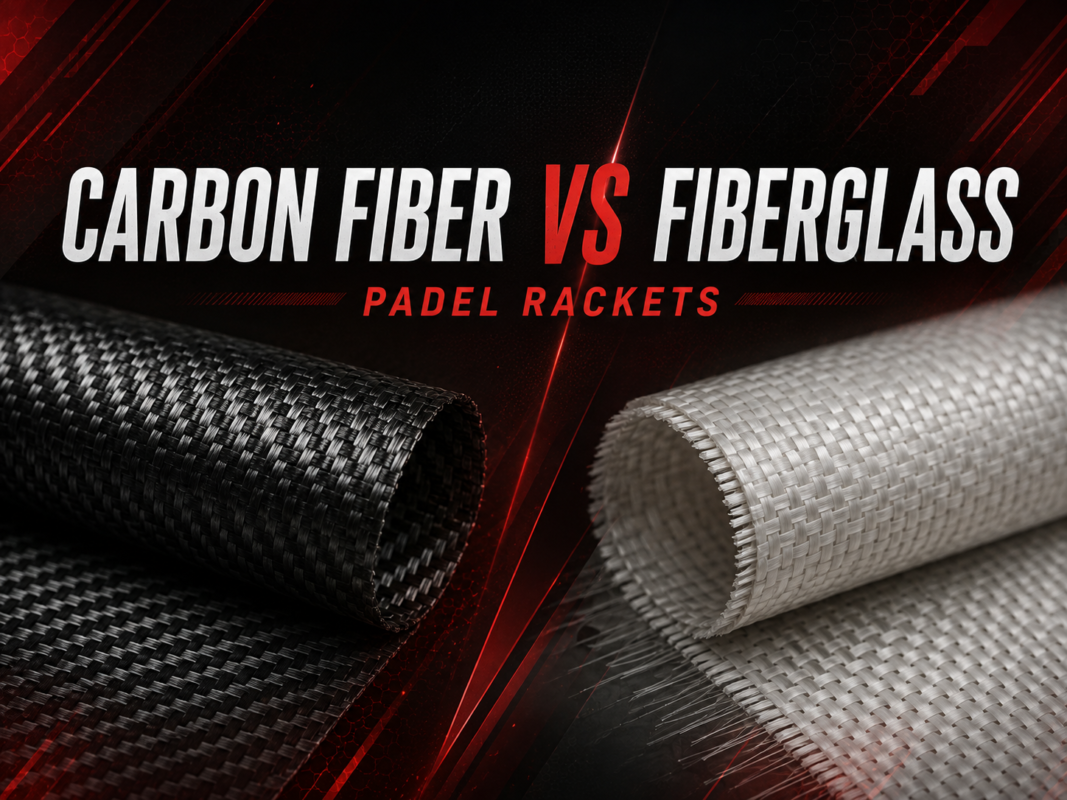
Carbon fiber vs fiberglass padel rackets is one of the most important material comparisons for brands developing a new racket. Both materials are widely used in padel racket construction, but they create different opportunities in stiffness, feel, weight efficiency, cost, appearance and product positioning.
For sports brands, the question is not simply whether carbon fiber is better than fiberglass. The correct material depends on the complete racket specification, including the laminate design, EVA foam core, resin system, geometry, weight, balance, finish and target player.
What Is Carbon Fiber in a Padel Racket?
Carbon fiber is a high-performance reinforcement material used in composite sports products because of its high stiffness and strength-to-weight characteristics. In padel rackets, carbon fabrics can be incorporated into the face, frame or complete laminate depending on the intended construction.
Carbon fiber can be supplied in different tow sizes, fabric weights, weave patterns and grades. Common visual designations in the padel market include 3K, 12K and 18K carbon fiber, but the K value alone does not define racket performance.
The behavior of a carbon-based racket depends on factors such as carbon grade, areal weight, weave, fiber orientation, ply count, resin content, EVA core and racket geometry.
What Is Fiberglass in a Padel Racket?
Fiberglass is another widely used reinforcement material in padel racket manufacturing. It is generally more flexible than carbon fiber and can be useful in rackets designed around comfort, accessibility, cost control or a softer overall response.
Fiberglass can be used as the primary face reinforcement, as part of the frame construction or in combination with carbon fiber in hybrid laminates.
Carbon Fiber vs Fiberglass Padel Rackets: Key Differences
| Factor | Carbon Fiber | Fiberglass |
|---|---|---|
| Stiffness | Generally higher | Generally lower and more flexible |
| Feel | More direct and crisp | Softer and more forgiving |
| Weight Efficiency | Strong advantage in performance-oriented laminates | Usually less efficient at equivalent stiffness targets |
| Cost | Higher material cost | Lower material cost |
| Visual Appearance | Distinct woven carbon look | Usually covered by coatings or graphics |
| Product Positioning | Performance and premium segments | Comfort, value and entry segments |
| Hybrid Use | Common | Common |
| Final Performance | Depends on complete construction | Depends on complete construction |
Stiffness and Feel
Carbon fiber is generally selected when a manufacturer or brand wants to create a stiffer, more direct composite structure. Fiberglass is more flexible and can contribute to a softer feel.
However, face material alone does not define stiffness. A carbon racket can still be designed to feel relatively soft when combined with a softer EVA core, a different laminate thickness or different fiber orientation.
Power and Ball Response
Stiffer constructions can provide a more immediate transfer of load through the face and may suit products designed for a more direct response. More flexible constructions can deform to a greater degree during impact, which may create a softer response.
Comfort and Flexibility
Fiberglass can be useful when a brand wants a more flexible construction and a softer feel at impact. Carbon fiber can also be incorporated into comfortable rackets, but the complete structure must be developed around that target.
Durability and Structural Behavior
Carbon fiber and fiberglass both have useful structural properties, but they behave differently under load. Carbon fiber offers high stiffness and strength efficiency, while fiberglass typically provides higher elongation and greater flexibility before failure.
Racket durability also depends on resin quality, fiber wet-out, cure conditions, laminate transitions, frame design, impact zones and manufacturing consistency.
Weight and Racket Construction
Carbon fiber can help a manufacturer achieve stiffness targets with efficient reinforcement layouts, which is one reason it is common in performance-oriented rackets.
Final racket weight is influenced by the entire product:
- Face and frame reinforcement
- EVA foam density
- Resin content
- Number of plies
- Paint and finishing system
- Grip and handle components
- Hole pattern and geometry
Cost and Product Positioning
Fiberglass is generally more economical than carbon fiber and can therefore suit price-sensitive product lines, beginner collections or high-volume private-label projects.
Carbon fiber usually supports higher product positioning because of its material cost, structural characteristics and visible woven appearance.
Carbon Fiber Grades and Fabric Construction
The term “carbon fiber” covers many possible material specifications. Two carbon fabrics can behave very differently even if both are sold under the same K designation.
- Fiber grade and modulus
- Tow size
- Areal weight or GSM
- Plain weave, twill weave or other construction
- Fiber orientation
- Laminate thickness
- Resin content
This is why brands should define a laminate specification rather than relying only on marketing terms such as 3K, 12K or 18K.
Hybrid Carbon Fiber + Fiberglass Constructions
A padel racket does not have to use only one reinforcement type. Carbon fiber and fiberglass can be combined within the same laminate to create a hybrid construction.
Hybrid constructions can help manufacturers tune stiffness, flexibility, weight and cost around a specific product target.
Which Material Should a Brand Choose?
The best material depends on the product brief. A brand should first define the target player, price point, desired feel, stiffness, weight, balance and visual positioning.
Target Player → Product Positioning → Shape → EVA Core → Laminate Design → Carbon/Fiberglass Selection → Prototype → Testing → Final Production Specification
Carbon Fiber vs Fiberglass for OEM Padel Rackets
For OEM and ODM projects, material selection should be tied to commercial positioning as well as technical performance.
- Fiberglass model for accessible pricing and comfort
- Hybrid carbon/fiberglass model for balanced positioning
- Full carbon model for premium or performance-focused ranges
Frequently Asked Questions
Not universally. Carbon fiber generally provides higher stiffness and better weight efficiency, while fiberglass can provide more flexibility, comfort and lower cost. The best choice depends on the complete racket design.
No. Fiberglass can be used in many product concepts, including comfort-oriented and hybrid constructions.
No. Power depends on the complete racket system, including stiffness, EVA core, weight, balance, shape and laminate.
Yes. Hybrid laminates can combine carbon fiber and fiberglass to achieve specific stiffness, flexibility, cost and weight targets.
Final Thoughts
Carbon fiber and fiberglass are both valuable materials in padel racket manufacturing. Carbon fiber is generally preferred when stiffness, weight efficiency and premium positioning are important, while fiberglass can be useful when flexibility, comfort and cost efficiency are priorities.
The final performance of a padel racket is determined by the complete construction rather than a single material label.
Develop a Custom Padel Racket With LeoEdge
Looking to develop a carbon fiber, fiberglass or hybrid padel racket for your brand?
Start Your Padel Racket Project