
Padel Racket Manufacturing
Epoxy Resin Systems in Padel Racket Manufacturing
Aug
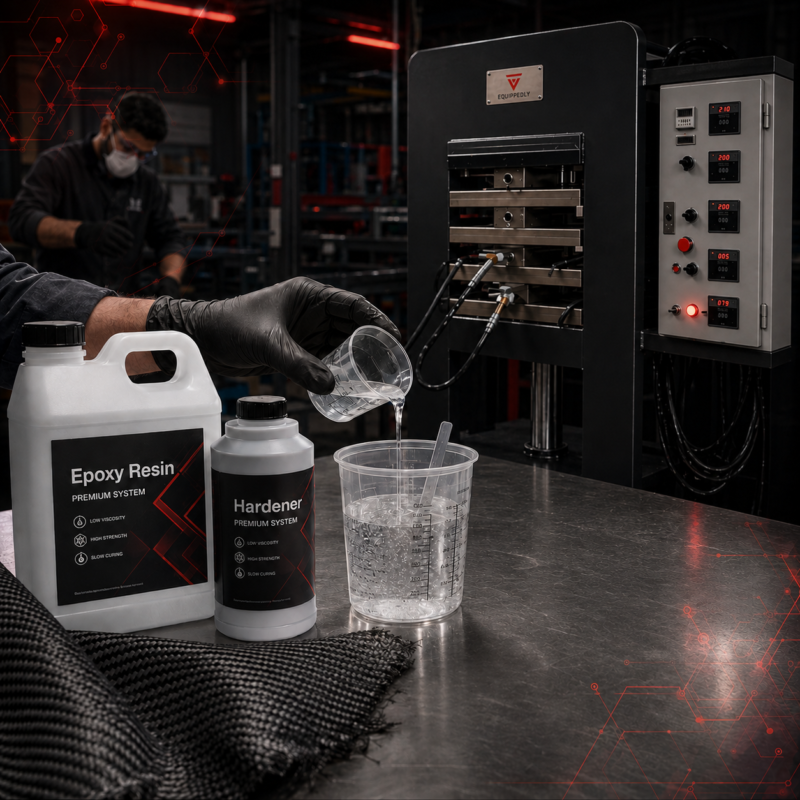
Epoxy resin systems in padel racket manufacturing play a critical role in bonding carbon fiber, fiberglass and other reinforcement layers into a consolidated composite structure. The resin system affects processing, fiber wet-out, cure behavior, heat resistance, toughness and the consistency of the finished racket.
Epoxy should not be evaluated as a single ingredient. A practical resin system includes the base epoxy resin, hardener or curing agent, any approved modifiers or additives, the specified mix ratio and the complete cure cycle. The final racket performance depends on how this system interacts with reinforcement, EVA core, mold temperature, pressure and production control.
What Is an Epoxy Resin System?
An epoxy resin system is a reactive combination of an epoxy resin and a compatible curing agent. When mixed in the correct proportion, the components react and form a crosslinked thermoset polymer.
In composite racket manufacturing, the uncured resin must first flow sufficiently to wet the reinforcement, then cure into a solid matrix that holds the fiber architecture in position and transfers load between fibers.
Role of Epoxy Resin in Padel Racket Manufacturing
The carbon or glass fibers provide much of the directional reinforcement in a composite laminate, while the cured epoxy matrix performs several supporting functions.
- Bonds reinforcement layers together
- Transfers load between neighboring fibers and plies
- Maintains the designed fiber orientation
- Supports the laminate against local deformation
- Helps protect fibers from handling and environmental exposure
- Connects composite skins with adjacent structural regions
The resin therefore influences both manufacturability and structural consistency. Too little resin can lead to poor impregnation or dry areas, while excessive resin can add unnecessary weight and create resin-rich regions.
Epoxy Resin, Hardener and Additives
Base Epoxy Resin
The base resin provides the primary epoxy functionality. Commercial systems vary in viscosity, reactivity, thermal performance and compatibility with different curing agents.
Hardener or Curing Agent
The hardener reacts chemically with the epoxy groups. Its chemistry strongly affects cure rate, working time, final crosslink density and temperature resistance.
Modifiers and Additives
Some formulated systems may contain approved tougheners, accelerators, reactive diluents, fillers or other additives. These can alter viscosity, cure behavior, toughness or processing characteristics.
Any additive should be part of a controlled formulation. Random solvent or additive changes can disturb stoichiometry, cure quality or final properties.
Why Epoxy Mix Ratio Matters
Epoxy systems depend on the correct stoichiometric relationship between resin and curing agent. The required ratio may be specified by weight or by volume, and the two should not be treated as interchangeable unless the supplier explicitly provides both.
Incorrect mixing can leave unreacted components in the cured laminate and may cause:
- Soft or under-cured resin
- Reduced thermal resistance
- Lower mechanical consistency
- Surface tackiness
- Long or unpredictable cure times
- Batch-to-batch variation
Viscosity and Fiber Wet-Out
Viscosity determines how easily uncured resin flows around and through the reinforcement. In wet layup or resin-applied processes, the system must be workable enough to impregnate the fabric before gelation.
Very high viscosity can make wet-out more difficult, especially with tightly packed fabrics or multiple reinforcement layers. Very low viscosity may improve flow but does not automatically mean better laminate quality because the resin must still remain in the intended laminate region during consolidation.
Processing temperature also influences viscosity. Most liquid resin systems become less viscous as temperature increases, but higher temperature can also accelerate reaction and reduce working time.
Pot Life and Working Time
Pot life describes the usable time of a mixed resin system under defined conditions. It is not a universal property because it changes with temperature, mixed quantity, container geometry and formulation.
A larger mixed mass can heat itself more rapidly through the exothermic cure reaction, shortening usable working time. For production, resin should therefore be mixed in controlled batches appropriate for the layup cycle.
Why Pot Life Matters in Racket Production
- Enough time is needed for complete wet-out and layup
- Resin viscosity should remain consistent during placement
- Late-stage application should not occur after excessive reaction has started
- Operators need repeatable batch timing
Cure Temperature and Cure Time
Epoxy cure is controlled by both chemistry and temperature. Some systems can develop initial properties at room temperature, while others are designed for elevated-temperature cure or post-cure.
For compression-molded padel rackets, the resin system must be compatible with the mold temperature and the production cycle. The target is not merely to make the part hard enough to demold; the cure schedule should develop the properties required by the approved material system.
| Processing Factor | Why It Matters |
|---|---|
| Mold temperature | Controls reaction rate, viscosity development and cure progression. |
| Cure time | Must be sufficient for the selected system at the actual part temperature. |
| Heating uniformity | Uneven mold temperature can create inconsistent cure across the racket. |
| Demold temperature | Must suit the resin, EVA/core behavior and dimensional stability. |
| Post-cure | Some systems may require or benefit from a specified post-cure to reach intended thermal properties. |
Glass Transition Temperature (Tg) in Epoxy Systems
The glass transition temperature, commonly called Tg, is the temperature region where a cured polymer matrix transitions from a relatively glassy condition toward a more rubber-like response.
For a composite sports product, Tg is relevant because the resin matrix should maintain adequate stiffness and dimensional stability within the expected service and processing environment.
The achieved Tg depends on the resin chemistry and the degree of cure. A high-temperature-capable resin that is insufficiently cured may not reach the thermal performance stated for a fully cured system.
Epoxy Toughness vs Stiffness
A very rigid resin matrix is not always the most damage-tolerant choice. Composite rackets experience repeated impact, local stress concentrations and flexural loading, so toughness can be important alongside stiffness and heat resistance.
Toughened epoxy systems are formulated to improve resistance to crack initiation or propagation while maintaining useful structural properties. The exact balance depends on the chemistry and laminate design.
For racket development, the objective should be a resin system that supports the intended laminate without creating an unnecessarily brittle matrix.
Epoxy With Carbon Fiber and Fiberglass
Epoxy can be used with both carbon fiber and fiberglass reinforcement. The resulting laminate behavior is dominated by the entire composite system rather than the resin alone.
Carbon fiber generally supports higher-stiffness constructions, while fiberglass can provide a more compliant laminate. Epoxy must wet and bond the selected reinforcement while maintaining appropriate cure and process compatibility.
Epoxy Resin and EVA Core Integration
A padel racket is not simply a flat composite laminate. The reinforcement and resin are formed around an EVA core and frame geometry during molding.
The resin system and cure cycle therefore need to be compatible with the complete assembly. Excessive heat, unsuitable pressure or poor cycle control can affect dimensional stability, bonding or core behavior.
The core hardness also influences the mechanical character of the finished racket and should be specified together with laminate and resin selection.
Common Resin-Related Defects in Padel Racket Manufacturing
Composite defects can have several causes, so a visible problem should not automatically be blamed on resin chemistry. However, resin control is an important part of defect prevention.
Dry Fiber Areas
May result from insufficient resin, poor wet-out, high viscosity or inadequate application.
Resin-Rich Areas
Excess matrix can add weight and create local regions with less efficient reinforcement.
Under-Cure
Can be associated with wrong ratio, inadequate time, low temperature or incompatible components.
Voids
Entrapped air, volatile contamination, poor consolidation or process issues can create voids.
Variable Hardness
May indicate inconsistent mixing, cure temperature or material control.
Delamination
Can involve resin, contamination, layup, cure or structural design and requires root-cause analysis.
Quality Control for Epoxy Resin Systems
Production quality control should begin before the resin reaches the mold. Consistency depends on storage, measurement, mixing, timing and cure control.
Incoming Material Control
- Supplier and product identification
- Batch or lot number
- Shelf-life status
- Storage condition verification
- Visual inspection for contamination or abnormal condition
Mixing Control
- Calibrated weighing equipment
- Correct resin-to-hardener ratio
- Defined mixing procedure
- Batch size control
- Mix time and use-time recording
Cure Control
- Mold temperature monitoring
- Cycle-time recording
- Repeatable press conditions
- Post-cure verification where specified
For more advanced qualification, manufacturers may use methods such as DSC, DMA, hardness testing or other material-specific tests depending on the resin supplier and internal quality plan.
How to Select an Epoxy Resin System for Padel Rackets
The best epoxy resin system is not simply the strongest resin on a datasheet. It must fit the manufacturing process and the target racket construction.
A useful selection process should consider:
- Compatibility with carbon fiber and fiberglass reinforcement
- Viscosity and wet-out behavior
- Required working time
- Compression-molding cure temperature
- Required demold cycle
- Target Tg
- Toughness and damage tolerance
- Bonding to the complete racket assembly
- Storage and production handling
- Supplier technical support and batch consistency
Product Requirement → Reinforcement & Core → Process Temperature → Working Time → Resin System Selection → Trial Laminate → Molded Prototype → Mechanical/QC Evaluation → Production Approval
Epoxy Resin Systems for OEM and ODM Padel Racket Development
For OEM and ODM production, resin should be part of the approved technical specification rather than an uncontrolled shop-floor choice.
When developing a new racket, brands and manufacturers should agree on the laminate concept, core specification, mold cycle and target performance before final resin approval.
Once a resin system is qualified, changing resin, hardener, mix ratio or cure schedule can change the laminate behavior and should be treated as a controlled material or process change.
Frequently Asked Questions
Epoxy acts as the matrix that bonds reinforcement layers, transfers load between fibers and consolidates the composite structure during cure.
Not automatically. Excess resin can increase weight and create resin-rich areas. Composite performance depends on the correct fiber-to-resin balance, layup and cure quality.
The mix ratio should follow the resin-system supplier’s specification. Changing the ratio can leave unreacted components and reduce cure consistency or final properties.
Tg is the glass transition temperature region where the cured polymer matrix shifts from a relatively glassy condition toward a more rubber-like response.
No. The required Tg must be balanced with processing capability, cure schedule, toughness and the actual service requirements of the racket.
Final Thoughts
Epoxy resin systems in padel racket manufacturing are a fundamental part of composite quality. The resin must wet the reinforcement effectively, provide sufficient working time, cure consistently and develop the thermal and mechanical properties required by the racket design.
Manufacturers should control the entire system: resin, hardener, mix ratio, batch size, working time, mold temperature and cure cycle. Good composite performance comes from controlling these variables together with fiber architecture, EVA core, geometry and molding conditions.
Develop Your Composite Padel Racket With LeoEdge
LeoEdge Enterprises works with brands on reinforcement selection, EVA core, laminate architecture, molding and OEM/ODM padel racket development.
Start Your Padel Racket Project